

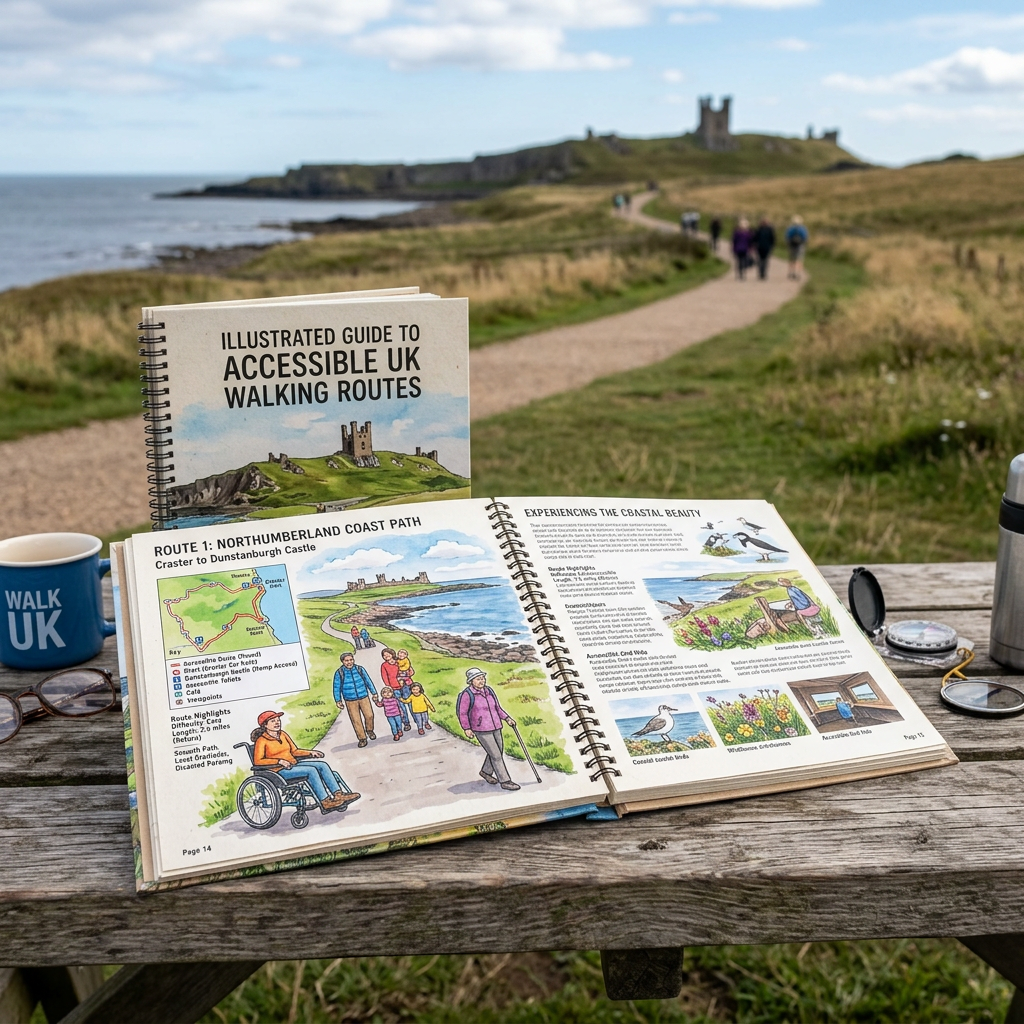
Finding wheelchair accessible walks in the UK can be difficult because many routes are described as “easy” or “flat” without actually being suitable for wheelchairs, mobility scooters, or people with reduced mobility.
This guide explains how to reliably identify wheelchair accessible walking routes, what details to check before visiting, and how to avoid misleading or incomplete accessibility information.
Why “Easy Walks” Are Not Always Accessible
A common issue in UK walking guides is the use of vague terms.
Labels like:
- Easy walk
- Leisure trail
- Short route
- Scenic path
do not guarantee accessibility.
A truly accessible route must be assessed using specific physical criteria, not general descriptions.
Step 1: Use the Right Search Terms
Start your search using accessibility-focused keywords.
Use:
- Wheelchair accessible walks UK
- Step-free walks UK
- Accessible trails UK
- Mobility scooter-friendly walks UK
- Accessible walking routes UK
Avoid:
- Nice walks near me
- Easy hikes
- Best countryside walks
These often return results that are not accessible.
Step 2: Prioritise Trusted Information Sources
Always check reliable providers before blogs or social media.
Best sources include:
- National Park Authority websites
- Local council walking guides
- Country Park official pages
- Forestry and land management sites
These usually provide:
- Surface type details
- Gradient information
- Step-free access notes
- Parking and facilities
Step 3: Check Core Accessibility Features
A route should be assessed based on physical conditions.
Surface type
- Tarmac or smooth concrete = suitable
- Compacted gravel = usually suitable
- Grass, sand, mud = often unsuitable
Gradient
- Flat or gently sloping = accessible
- Steep hills or uneven climbs = limiting
Barriers
Check for:
- Steps
- Stiles
- Narrow gates
- Bollards or blocked entrances
Even one barrier can make a route inaccessible.
Step 4: Use Mapping Tools Before You Go
Digital maps help verify accessibility visually.
Check:
- Car park location and distance to the path
- Continuity of walking routes
- Surface appearance using satellite view
- Entrances and potential barriers
Tools like Google Maps Street View can reveal access issues before visiting.
Step 5: Check Real User Feedback
User reviews often provide the most practical accessibility insights.
Look for comments mentioning:
- Wheelchair or mobility scooter use
- Path surface condition
- Accessibility of entrances
- Recent visits and current conditions
Avoid relying on:
- General comments like “lovely walk”
- Outdated reviews
- Non-specific descriptions
Step 6: Focus on Naturally Accessible Locations
Some environments are more likely to be suitable.
Good options include:
- Country parks with maintained paths
- Coastal promenades
- Canal towpaths in urban areas
- Converted railway paths (rail trails)
- Managed nature reserves
These are more likely to offer consistent accessibility.
Step 7: Plan Before You Travel
Before visiting any route, confirm:
- Parking availability and distance to the path
- Step-free access from the arrival point
- Toilet and facility access
- Route length and estimated time
- Weather conditions for the day
Small planning steps prevent major accessibility issues.
Common Mistakes to Avoid
Avoid:
- Assuming “easy” means wheelchair accessible
- Ignoring surface type details
- Overestimating short distances
- Skipping recent accessibility reviews
- Not checking access from the car park
These are the most common causes of unsuitable route selection.
Final Thoughts
Finding wheelchair accessible walks in the UK becomes much easier when you focus on verified physical accessibility details rather than general descriptions. By checking surfaces, gradients, barriers, and real user feedback, you can confidently choose routes that genuinely meet accessibility needs.