
The Scottish Highlands can look uncompromising on a map: jagged peaks, long glens, and vast empty space. But the reality on the ground is more nuanced. Some of the most powerful landscapes here don’t require climbing at all; they unfold from lochside paths, glen floors, forest tracks, and carefully chosen viewpoints.
This guide focuses on those lower-impact, high-reward experiences where the Highlands stay accessible without losing their scale.
Fort William & Loch Linnhe: Big Landscape, Flat Access
Fort William is one of the most practical bases for accessible exploration.
Key accessible-friendly features:
- Loch Linnhe shoreline paths (sections near town): generally flat, with long-range water and mountain views
- Wide pavements and waterfront promenades in parts of the town
- Easy access to cafés and transport links without steep gradients
The landscape here does the work for you; towering mountains appear immediately without needing to climb them.
https://bidfortwilliam.co.uk/getting-around-fort-william-a-practical-guide-for-visitors/
Glencoe Valley Floor: Drama Without the Ascent
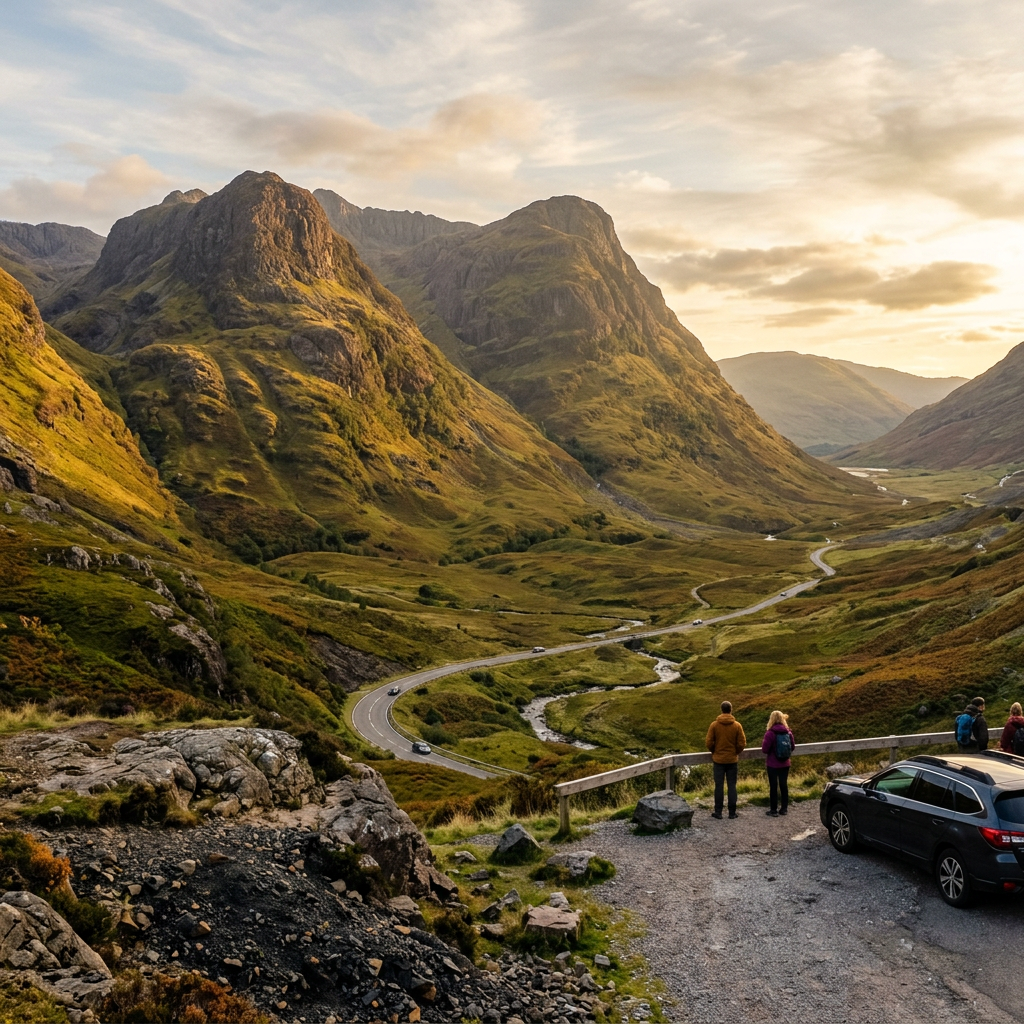
Glencoe is one of the most visually intense places in the UK, and you don’t need to hike it to feel that intensity.
Accessible highlights include:
- Roadside viewpoints along the A82 corridor
- Flat valley-floor pull-ins with sweeping views of Buachaille Etive Mòr
- Short, compact walks at selected viewpoints (variable surfaces, but minimal distance required)
This is a “stop-and-stare” landscape; its scale is immediate and unavoidable.
Loch Ness: Long, Gentle Shoreline Experiences
Loch Ness offers one of the most consistently accessible large-scale landscapes in the Highlands.
Good access points include:
- Fort Augustus canal area: level paths, bridges, and viewing spots
- Selected sections near Drumnadrochit with smoother lakeside access
- Visitor centres with accessible facilities and structured viewpoints
You don’t need to search for scenery here; it surrounds you continuously.
Cairngorms National Park: Forests & Easy-Grade Trails
Cairngorms National Park is often misunderstood as extreme terrain only, but it contains some of the most accessible managed trails in Scotland.
Accessible highlights:
- Rothiemurchus Forest (selected trails): wide, compact forest tracks with minimal gradient
- Loch an Eilein: one of the most accessible scenic circuits in the region (gravel, but generally even)
- Visitor centres with barrier-free viewpoints and interpretation areas
The forest structure is flat, sheltered, and predictable underfoot compared to exposed mountain terrain.
Loch Lomond: Gateway Highlands Accessibility
Loch Lomond sits at the southern edge of the Highlands and is one of the easiest large lochs to access.
Accessible features:
- Balloch Country Park: paved lochside routes and open parkland
- Level waterfront promenades with long-distance views
- Boat trips (seasonal) offering seated access to the wider loch
It’s often the most practical “first Highlands experience” for visitors who need reliable terrain.
Glen Coe to Fort William Corridor: Viewpoints Over Walking
The A82 corridor between these two hubs is one of the most accessible scenic drives in Europe.
Key accessible-style stops:
- Multiple lay-bys with direct mountain views
- Minimal walking is required to experience major scenery
- Constant visual transitions between lochs, cliffs, and glacial valleys
This is one of the few places where “roadside access” still feels like wilderness immersion.
Practical Accessibility Notes
- Surfaces vary dramatically: paved town paths can switch to rough gravel quickly
- Weather changes are extreme and can affect accessibility within hours
- Distances between facilities can be long; planning stops matter
- The best strategy is hub-based: Fort William, Aviemore, or Balloch as anchors
The Character of Accessible Highlands Travel
The Highlands don’t need to be made smaller to be accessible; they need to be approached horizontally rather than vertically.
Lochs replace summits. Valleys replace ridgelines. Viewpoints replace ascents.
And the result isn’t a reduced experience; it’s a different way of meeting the same scale.