
Finding an accessible walking route should not mean arriving somewhere and hoping the path lives up to its description.
Terms such as easy, flat, short, and even accessible can mean very different things from one location to another. A route may have no steps but still involve loose gravel, steep gradients, or a long distance from the car park. Another route might be several kilometres long but provides smooth surfaces, regular seating, accessible toilets, and plenty of opportunities to turn back.
The key is to look beyond the label.
At Access Trails UK, we believe accessible walking is about understanding the actual conditions of a route and deciding whether those conditions are likely to work for you, your mobility equipment, and the people you are travelling with.
This guide explains what to look for when choosing an accessible walking route in the UK.
What makes a walking route accessible?
There is no single feature that makes every route accessible to every person.
Accessibility can depend on a combination of:
- Surface
- Gradient
- Route width
- Steps and changes in level
- Gates and barriers
- Distance
- Seating and rest points
- Toilets and other facilities
- Parking and public transport
- Weather and seasonal conditions
- The person’s own mobility, stamina and equipment
This is why a route should ideally be described in practical terms rather than simply being given an “accessible” or “not accessible” label.
A wheelchair user, mobility scooter user, person using walking sticks, and someone with limited stamina may all have very different requirements.
The best accessible route is not necessarily the shortest or flattest route. It is the route whose conditions match the needs of the person using it.
1. Start with the surface
The surface underneath your feet or wheels can make a dramatic difference.
Tarmac and concrete
Smooth, firm surfaces are often among the easiest to navigate.
They can be particularly useful for:
- Wheelchairs
- Mobility scooters
- Walking frames
- People who find uneven ground difficult
However, even a tarmac route can contain problems such as steep gradients, broken surfaces, drainage channels, or raised edges.
Compact gravel
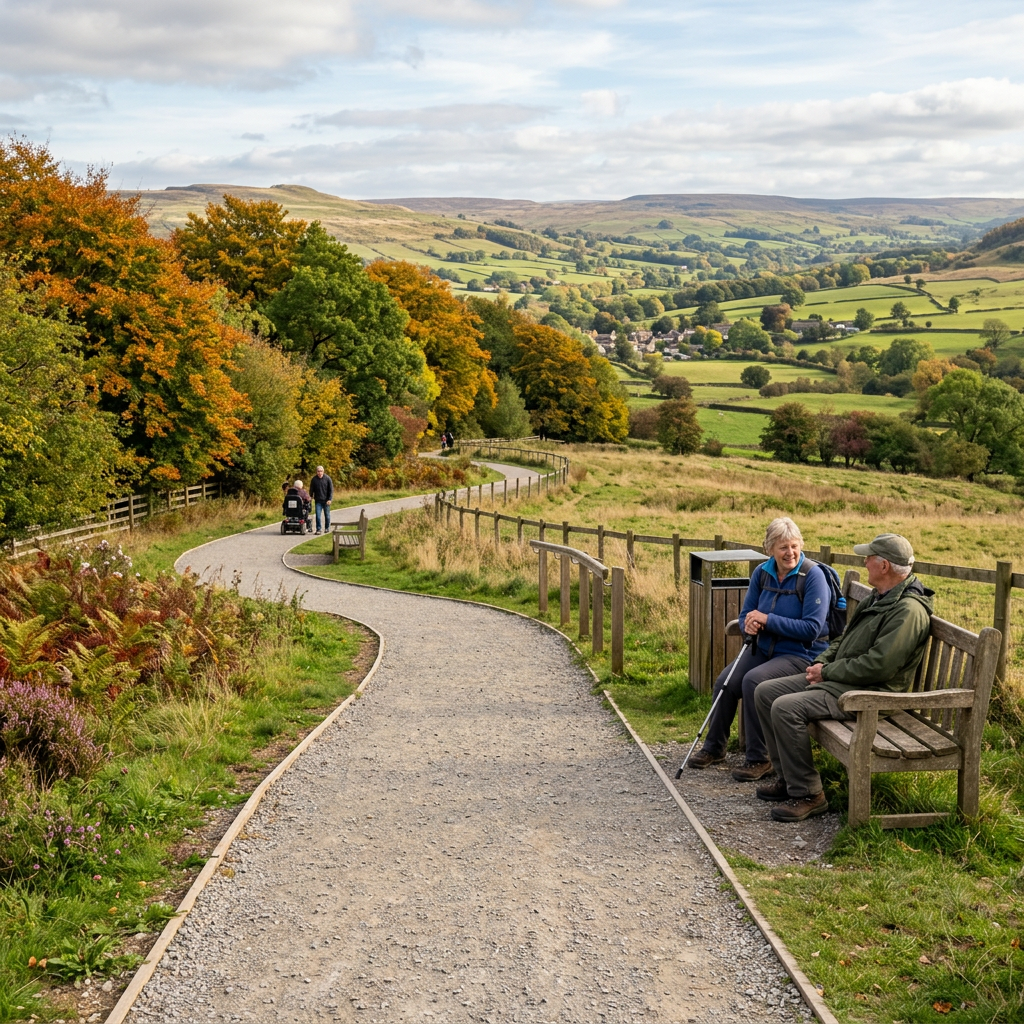
Well-maintained compact gravel can provide a relatively stable surface.
But “gravel” is not a sufficiently detailed description on its own.
There is a significant difference between a firm, compacted gravel path and deep, loose stones that move underneath wheels or feet.
Boardwalks
Boardwalks can provide excellent access through environments where the natural ground would otherwise be difficult.
Check for:
- Width
- Surface condition
- Gaps between boards
- Steep ramps
- Handrails
- Passing places
Grass and natural ground
Grass can look perfectly flat while being surprisingly difficult to navigate.
Wet grass, soft ground, hidden holes, tree roots, and uneven terrain can all affect accessibility.
This is particularly important after periods of heavy rain.
Sand, mud, and loose surfaces
These surfaces can be challenging for many forms of mobility equipment.
If a route includes them, the important question is not simply whether they exist, but how much of the route they occupy and whether there is a suitable alternative.
For more details, see our forthcoming guide to [accessible walking surfaces].
2. Look carefully at the gradient
A route described as “mostly flat” may still contain a short but significant climb.
For some visitors, a short steep section may be more important than the overall distance.
When assessing a route, look for:
- Long gradual inclines
- Short steep sections
- Downhill sections
- Sloping surfaces across the width of the path
- Ramps
- Changes in level
- Uneven approaches to viewpoints or facilities
Remember that gradients affect people differently.
A wheelchair user may be particularly concerned about the ability to ascend or control a descent. Someone using a walking aid may find a downhill section more difficult than an uphill section.
This is why “flat” should describe the actual route rather than simply its general character.
3. Check for steps, gates, and other barriers
A route can be beautifully surfaced and relatively flat but still be inaccessible because of a single barrier.
Look for:
- Steps
- Stiles
- Narrow gates
- Heavy gates
- Turnstiles
- Bollards
- Narrow bridges
- Steep kerbs
- Uneven entrances
Also consider whether a barrier is present at the beginning of the route.
A supposedly accessible trail is of limited use if the only accessible section can be reached by crossing steps or a narrow entrance.
Where possible, check the entire journey from the accessible parking area or public transport stop to the actual trail.
4. Consider the width of the route
Width is easy to overlook.
A path may have a good surface and no steps but still become difficult if it is too narrow for a wheelchair, mobility scooter, or people walking alongside each other.
Consider whether there is:
- Enough width for your equipment
- Space to turn around
- Room for people to pass
- A safe place to stop
- A suitable alternative if another visitor is approaching
Narrow paths can also become more difficult when vegetation grows across the edges.
5. Think about distance differently
Distance is important, but it does not tell the whole story.
A 1 km route with no seating, a steep gradient, and difficult surfaces may be considerably more demanding than a 3 km route on a smooth, level path with regular benches.
When checking distance, consider:
Is it one-way or return?
A route described as 2 km may mean:
- 2 km total, or
- 2 km each way
Always check.
Can you turn back?
A route with a straightforward return option can be much more flexible.
If energy levels change, you should ideally be able to shorten the outing without having to complete the entire route.
Are there places to rest?
Benches and other resting points can make a substantial difference.
Accessibility is not only about removing physical barriers. It is also about making a route manageable.
6. Check the facilities
Facilities can determine whether an accessible walk works as a short outing or a much longer day.
Before travelling, look for:
- Accessible toilets
- Changing Places facilities where available
- Benches
- Sheltered seating
- Picnic areas
- Cafés
- Visitor centres
- Shops
- Water facilities
- Accessible viewing areas
A route without facilities is not necessarily inaccessible.
But knowing what is and is not available allows you to plan properly.
7. Look at the parking and arrival point
One of the most important parts of an accessible walk can happen before you reach the path.
Check:
- Is there designated accessible parking?
- How far is the parking area from the trail?
- Is the route between the parking area and the trail step-free?
- Is the car park surface firm?
- Are there dropped kerbs?
- Is there a suitable drop-off point?
- Are accessible toilets located near the parking area?
A trail can be wonderfully accessible while the journey from the car park creates an unexpected barrier.
That is why Access Trails considers the wider visitor experience rather than looking only at the path itself.
8. Consider public transport
You do not have to own a car to enjoy an accessible walk.
When planning an outing, consider whether the route can be reached by:
- Train
- Tram
- Bus
- Accessible taxi
- Community transport
- Other local transport
But again, look at the complete journey.
An accessible train station does not automatically mean an accessible walk if the route from the station to the trail includes steep pavements, steps, or difficult crossings.
Transport accessibility and trail accessibility need to be considered together.
9. Check the weather
Accessibility can change with conditions.
A firm path in dry weather may become muddy after heavy rain. Fallen leaves can conceal uneven surfaces, while frost can make slopes and boardwalks slippery.
Before setting out, consider:
- Recent rainfall
- Forecast temperatures
- Frost
- Snow
- Strong winds
- Heat
- Mud
- Seasonal vegetation
- Coastal conditions
- Recent maintenance
This is particularly important for routes involving natural surfaces.
A route description can be accurate while conditions on the ground have changed.
10. Think about who is using the route
There is no universal definition of an accessible walk.
A route might work well for one person and be unsuitable for another.
Wheelchair users
Important considerations may include:
- Surface firmness
- Gradient
- Width
- Turning space
- Kerbs
- Gates
- Accessible toilets
- Parking
Mobility scooter users
In addition to the above, consider:
- Route width
- Turning areas
- Surface stability
- Battery range
- Charging opportunities
- Access through gates and barriers
People using walking aids
Useful features may include:
- Smooth surfaces
- Rest benches
- Handrails where appropriate
- Manageable gradients
- Shorter route options
- Toilets and seating
People with limited stamina
Distance and gradient may be particularly important.
A route with regular opportunities to stop may be much more suitable than a shorter route with nowhere to rest.
Families and mixed-ability groups
The needs of one member of a group should not be considered in isolation.
A route that works for a wheelchair user may also need to accommodate companions, children, pushchairs, assistance dogs, or people with different walking abilities.
11. Do not rely on the word “easy”
One of the most useful habits when planning an accessible walk is to question broad descriptions.
Easy does not necessarily mean accessible.
Similarly:
- Short does not necessarily mean easy.
- Flat does not necessarily mean step-free.
- Step-free does not necessarily mean wheelchair-friendly.
- Scenic does not necessarily mean accessible.
- A popular route does not necessarily suit every mobility need.
Instead of asking:
“Is this an easy walk?”
Ask:
“What are the actual conditions of this route?”
That question gives you much more useful information.
12. Look for alternatives and shorter options
A good accessible destination does not necessarily have to offer one perfect route.
Sometimes the best option is a route with several choices.
For example:
Option A: A short, fully surfaced route to a viewpoint.
Option B: A longer route continuing around a lake.
Option C: A partial route that can be turned around whenever needed.
This kind of flexibility can make outdoor spaces accessible to a much wider range of people.
You do not have to complete the longest route to have a worthwhile experience.
13. Check the route from beginning to end
One of the biggest mistakes in accessibility planning is checking only the main trail.
Instead, think about the whole journey:
Home → transport → parking → entrance → facilities → trail → viewpoint or destination → return journey
Ask at every stage:
- Is it step-free?
- Is the surface suitable?
- Is there enough space?
- Are there barriers?
- Can I stop and rest?
- Is there somewhere to use the toilet?
- What happens if I need to turn around?
This approach can reveal problems that a conventional walking description might never mention.
A simple accessible-route checklist
Before setting out, ask:
- Is the route genuinely step-free?
- What is the surface?
- Is the surface firm and stable?
- Are there steep sections?
- Is there significant cross-slope?
- Are there gates, stiles, or narrow barriers?
- Is the path wide enough?
- How far is the actual walking distance?
- Is there somewhere to rest?
- Are accessible toilets available?
- Is accessible parking available?
- Can I reach the trail without encountering steps?
- Can I use public transport?
- What are the current weather conditions?
- Can I shorten the route if necessary?
- Does the route suit the person actually using it?
If you can answer these questions before you leave, you are much more likely to know what to expect.
Accessibility is about information as much as infrastructure
An important part of accessible walking is knowing what you are going to encounter.
A route does not have to be universally accessible to be useful.
What matters is providing enough accurate information for people to decide whether it works for them.
That means being honest about limitations.
A route with one short steep section should not necessarily be rejected as inaccessible. But that section should be clearly described so that someone can make an informed decision.
Likewise, a route with a good surface but no accessible toilet can still be valuable, provided visitors know this before they arrive.
Good accessibility information does not promise that every route will work for everyone. It gives people the information they need to choose confidently.
How Access Trails UK approaches accessible routes
Access Trails UK focuses on practical information rather than relying solely on labels such as “easy” or “accessible”.
Our route guides consider the features that can make a real difference to an outdoor visit, including surfaces, gradients, barriers, facilities, parking, transport, and the wider conditions around a trail.
We also recognise that accessibility is personal.
A route may be highly suitable for one visitor and unsuitable for another. That does not make the information contradictory; it makes an accurate route description more important.
Our aim is to help people understand what they can expect, so they can make their own informed decisions.
We also welcome feedback from people who have actually used routes. Conditions can change, maintenance can alter surfaces, and facilities can be updated, so community input remains an important part of improving accessibility information.
The best accessible walk is the one that works for you
Choosing an accessible walking route is not about finding a magic label.
It is about matching the route to the person.
Look beyond the headline description and consider:
surface + gradient + barriers + distance + facilities + transport + conditions + personal needs
That combination tells you far more than the word “easy” ever could.
And sometimes the most accessible choice is not the route with the fewest metres, the flattest profile, or the most impressive destination.
It is simply the route that lets you get outside, enjoy the surroundings, and return home knowing the experience worked for you.
That is what accessible walking should be about.
Frequently Asked Questions
What is an accessible walking route?
An accessible walking route is a route designed or maintained to reduce barriers for people with different mobility needs. However, accessibility varies considerably between routes and individuals, so it is important to check the specific surface, gradient, width, barriers, facilities, and other conditions.
Are all step-free walks wheelchair accessible?
No. A step-free route can still contain steep gradients, loose gravel, narrow sections, difficult gates, or other features that may make it unsuitable for some wheelchair users.
What is the best surface for an accessible walk?
Firm, stable surfaces such as well-maintained tarmac, concrete, and some compacted gravel routes can be suitable for many visitors. However, surface suitability depends on the individual and the condition of the route.
How far should an accessible walk be?
There is no universal maximum distance. A person’s mobility, stamina, equipment, and access to seating can all affect what distance is manageable. A longer, level route with rest points may be easier than a shorter route with steep sections.
Can accessible walks change with the weather?
Yes. Rain, frost, snow, heat, fallen leaves, and seasonal vegetation can all affect surfaces and conditions. Natural routes can be particularly susceptible to seasonal changes.
Does “easy walk” mean accessible?
No. “Easy” is a general description and does not necessarily tell you whether a route is step-free, wheelchair-friendly, or suitable for mobility equipment.
Where can I find accessible walks in the UK?
Access Trails UK provides guides to accessible routes across England, Scotland, Wales, Northern Ireland and the Republic of Ireland, with information designed to help visitors understand route conditions and plan with greater confidence.
Explore more accessible walking guidance
If you are planning an accessible outing, our other guides can help you look more closely at specific aspects of route accessibility, including walking surfaces, gradients, route planning, transport, and facilities.
And if you know a route that deserves to be better understood, you can also share your experience with Access Trails UK.
Accessible walking is not about telling people where they can and cannot go. It is about giving people better information so they can decide for themselves.