
When choosing an accessible walking route, one of the first things to check is the surface.
A route can be described as flat, easy, or even accessible, but the surface underneath your feet or wheels can make a significant difference to how manageable it actually is.
Smooth tarmac is very different from loose gravel. A compacted woodland path can behave differently after heavy rain. A boardwalk may provide an excellent route through a wetland but may introduce gaps, slopes, or narrow sections that need consideration.
There is no single surface that works for everyone.
The important thing is to understand what the surface is like, how consistent it is, how it changes with conditions, and how it interacts with the needs of the person using the route.
This guide explains the most common walking surfaces you are likely to encounter on accessible trails in the UK.
Why does the walking surface matter?
The surface affects:
- Stability
- Wheel traction
- Rolling resistance
- Balance
- Comfort
- Effort
- Manoeuvrability
- Turning
- Braking
- Wheelchair and mobility scooter performance
For someone walking independently, an uneven surface may simply be an inconvenience.
For someone using a wheelchair, mobility scooter, walking frame, or other mobility aid, the same surface may have a much greater impact.
This is why a useful accessibility description should say what the path is actually made from, rather than simply describing it as accessible.
1. Tarmac and asphalt
Tarmac is one of the most predictable surfaces for accessible walking.
It is commonly found on:
- Promenades
- Urban paths
- Country park routes
- Greenways
- Park roads
- Shared-use trails
- Accessible visitor routes
A smooth, well-maintained tarmac path can provide a firm and consistent surface for many wheelchair and mobility scooter users.
It can also make walking easier for people who find loose or uneven ground difficult.
What should you check?
Even a tarmac route can present challenges.
Look for:
- Potholes
- Cracks
- Raised edges
- Drainage channels
- Uneven repairs
- Steep gradients
- Cross-slopes
- Kerbs
- Narrow sections
A route should therefore not be considered accessible simply because it is surfaced with tarmac.
The condition and design of the path matter as much as the material itself.
2. Concrete
Concrete paths can provide another firm and predictable surface.
They are particularly common around:
- Seafronts
- Parks
- Visitor centres
- Urban areas
- Gardens
- Recreation areas
Smooth concrete can be suitable for many forms of mobility equipment.
However, joints between concrete sections can create small changes in level. Cracked or damaged concrete can also become a problem.
Look for:
- Uneven joints
- Cracks
- Broken sections
- Drainage channels
- Sloping edges
- Kerbs
Concrete can also become slippery when wet, particularly where algae or other growth has developed.
3. Compacted gravel
Gravel requires more explanation than the word suggests.
A firm, well-compacted gravel path can provide a relatively stable walking surface and may be suitable for many visitors.
But compacted gravel should not be confused with loose stone.
A properly maintained path may have:
- A firm base
- Fine aggregate
- Relatively little movement under wheels
- A reasonably even surface
This can make it considerably easier to navigate than loose gravel.
However, conditions can change.
Heavy rain, erosion, maintenance work, or repeated use can cause stones to become displaced.
4. Loose gravel and stones
Loose gravel can be considerably more difficult.
Wheels may sink or move sideways, while people walking with mobility aids may find it harder to maintain balance.
Potential problems include:
- Deep loose stones
- Uneven wheel tracks
- Slipping
- Reduced traction
- Increased effort
- Difficulty turning
The depth and size of the gravel matter.
A thin layer of small, compact stones can behave very differently from a deep surface of large, loose aggregate.
For this reason, simply describing a route as “gravel” does not give visitors enough information.
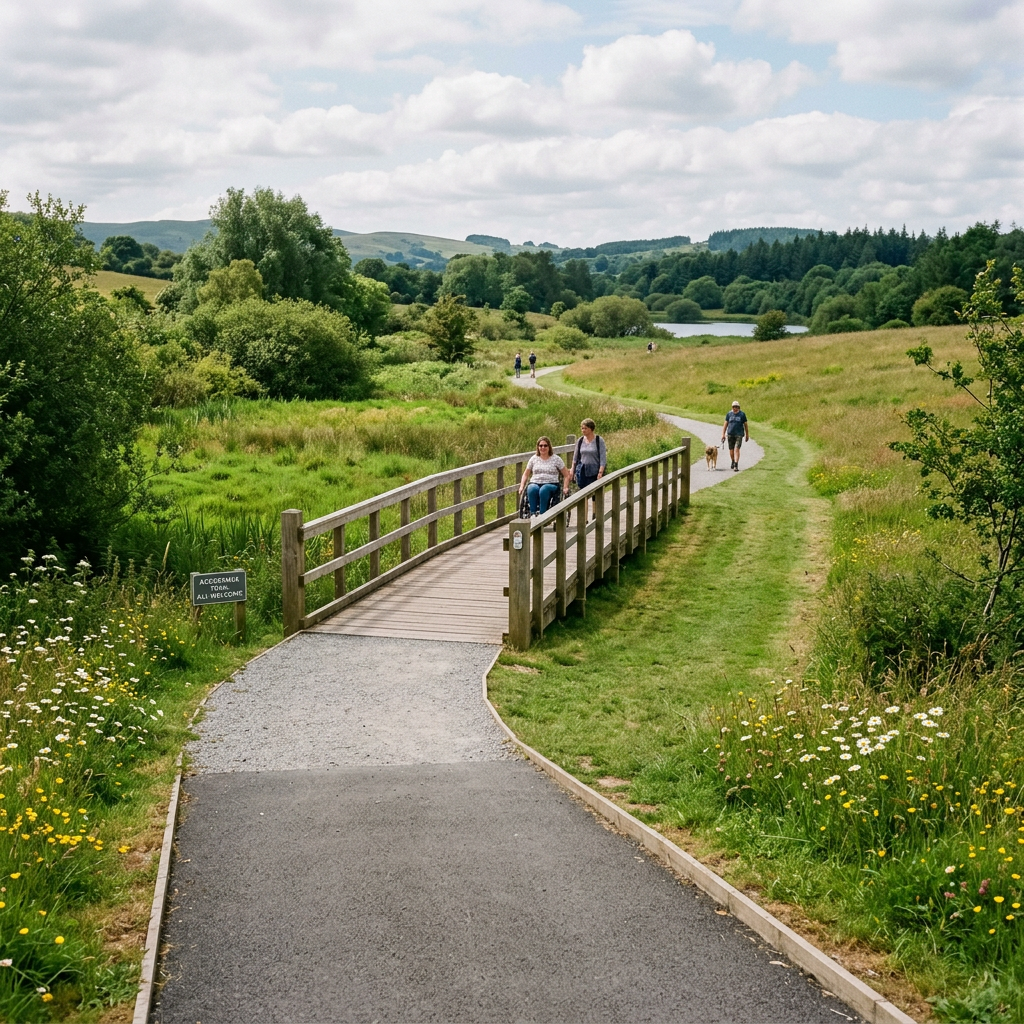
5. Boardwalks
Boardwalks can provide valuable access through environments where the natural ground would otherwise be difficult to navigate.
They are often found in:
- Wetlands
- Nature reserves
- Coastal areas
- Woodlands
- Lakeside environments
- Peatlands
A well-designed boardwalk can provide a firm and predictable route.
But there are several things to consider.
Check the width
Is there enough room for mobility equipment and other visitors to pass?
Check the gaps
Large gaps between boards may affect small wheels or walking aids.
Check the surface
Wet timber can become slippery.
Check the gradient
A boardwalk may include ramps or changes in level.
Check the edges
Look for raised edges, kerbs, or other features that could affect wheels.
Boardwalks can therefore be excellent accessible infrastructure, but the details still matter.
6. Paved paths
Paving can vary considerably.
Large, smooth paving slabs may provide an excellent surface.
Older or uneven paving can create:
- Raised edges
- Gaps
- Uneven joints
- Cracks
- Trip hazards
- Difficult transitions
Historic areas may also contain cobbles or irregular stone paving that looks attractive but is considerably more challenging for some visitors.
Where possible, look beyond the word “paved” and consider the actual condition.
7. Grass
Grass can be deceptively difficult.
A route may appear beautifully flat while the underlying ground is:
- Soft
- Uneven
- Waterlogged
- Rutted
- Sloping
- Full of hidden holes
Dry, short, well-maintained grass over firm ground may be manageable for some people.
Wet grass over soft soil can be a very different proposition.
This is one reason why seasonal conditions should always form part of accessibility information.
8. Natural earth and hard-packed paths
Natural paths can range from excellent to extremely challenging.
A firm, well-maintained earth path may be reasonably straightforward in dry conditions.
But roots, stones, erosion, and rainfall can quickly change the experience.
Look for:
- Tree roots
- Rocks
- Ruts
- Holes
- Erosion
- Mud
- Uneven edges
- Narrow sections
A natural path should therefore be assessed as it exists on the ground, rather than judged solely by its appearance.
9. Mud
Mud is one of the clearest examples of why accessibility can change over time.
A route that is firm in dry weather may become difficult after heavy rain.
Mud can affect:
- Traction
- Wheel grip
- Balance
- Walking effort
- Wheelchair propulsion
- Mobility scooter performance
- Cleaning and maintenance
Mud can also collect in low points, beside drainage problems, and on heavily used sections of trail.
If a route includes natural surfaces, it is worth checking recent weather and local conditions before setting out.
10. Sand
Sand can be particularly challenging for many mobility aids.
Deep, soft sand increases rolling resistance and can make wheels sink.
However, coastal routes vary considerably.
Some beaches and promenades have:
- Firm compacted sections
- Boardwalk access
- Beach wheelchairs
- Hard-surface promenades
- Accessible viewing areas
This means a coastal destination should not automatically be labelled accessible or inaccessible simply because it contains sand.
Look at the specific route and access provided.
11. Cobbles and uneven stone
Historic streets, castle grounds, and older towns can contain cobbles and irregular stone surfaces.
These can create:
- Vibration
- Uneven movement
- Difficult wheel travel
- Balance challenges
- Narrow gaps
- Changes in level
For some visitors, cobbles may be manageable over a short distance.
For others, they may make the route unsuitable.
Again, the important thing is an accurate description rather than a universal judgement.
12. Mixed surfaces
Many of the UK’s most interesting walks use more than one surface.
For example:
Car park → tarmac → compact gravel → boardwalk → natural path
This is much more useful information than simply calling the route “accessible”.
A route may be highly manageable for the first kilometre and become considerably more challenging later.
When planning, identify where the surface changes.
Surface transitions matter
One detail that is often overlooked is the transition between surfaces.
A smooth path can meet:
- A raised kerb
- A drainage channel
- Loose gravel
- Grass
- A threshold
- A bridge
- A gate
These transitions can sometimes create a bigger problem than the surface itself.
When assessing a route, therefore, think about how you get from one surface to another.
Weather can change the surface
The same route can provide different accessibility experiences throughout the year.
After heavy rain
Check for:
- Mud
- Flooding
- Puddles
- Erosion
- Slippery timber
- Soft ground
During winter
Look for:
- Frost
- Ice
- Snow
- Wet leaves
- Waterlogged ground
During summer
Dry weather can improve some natural paths, but heat can also affect exposed routes and increase the need for rest and water.
Accessibility information should therefore be understood as a snapshot of conditions rather than a permanent guarantee.
How should an accessible route describe its surface?
A useful route description should ideally tell you:
What is the surface?
How firm is it?
Is it consistent?
Are there uneven sections?
Does it change during the route?
Are there difficult transitions?
Could the weather significantly affect it?
That is much more useful than simply saying:
“This is an accessible trail.”
A simple surface guide
| Surface | What to look for |
| Smooth tarmac | Condition, gradients, kerbs and drainage |
| Concrete | Joints, cracks and slope |
| Compact gravel | Firmness and maintenance |
| Loose gravel | Depth, movement and traction |
| Boardwalk | Width, gaps, edges and ramps |
| Paving | Evenness and raised joints |
| Grass | Firmness, slope and weather |
| Natural earth | Roots, stones and erosion |
| Mud | Depth, drainage and recent rainfall |
| Sand | Firmness and depth |
| Cobbles | Vibration, gaps and unevenness |
| Mixed surface | Where and how surfaces change |
The key principle
There is no single “accessible surface”.
There are surfaces that may be more or less suitable depending on:
- The person
- Their mobility
- Their equipment
- The weather
- The condition of the path
- The length of the section
- The gradient
- The surrounding route
That is why Access Trails UK describes routes in practical terms wherever possible.
Good accessibility information tells you what the ground is actually like.
Frequently Asked Questions
Is tarmac the best surface for wheelchair users?
A smooth, well-maintained tarmac surface can be suitable for many wheelchair users, but it is not automatically accessible. Gradients, cross-slopes, kerbs, potholes, and other features still need to be considered.
Is gravel accessible?
Some compacted gravel surfaces may be suitable for many visitors, while deep or loose gravel can be considerably more difficult. The type, depth, and condition of the gravel matter.
Are boardwalks wheelchair accessible?
Some boardwalks provide excellent access, but width, gaps, gradients, edges, and surface condition should be checked.
Is grass suitable for mobility scooters?
It depends on the firmness and condition of the ground. Short, dry grass over firm ground can be very different from wet or soft grass.
Can rain make an accessible route inaccessible?
Rain can change the condition of natural surfaces and increase mud, standing water, and slipperiness. It is therefore important to consider current conditions rather than relying entirely on a historic route description.
What is the most accessible walking surface?
Firm, stable, and relatively smooth surfaces are often easier for many visitors, but there is no universal answer. Individual needs and route conditions always matter.
Explore the next Access Trails guide
Understanding the surface is only part of choosing an accessible route.
The next question is often just as important:
How steep is the route?
Our guide to accessible walking and gradients explains why “flat”, “gentle” and “mostly level” can mean very different things in practice.